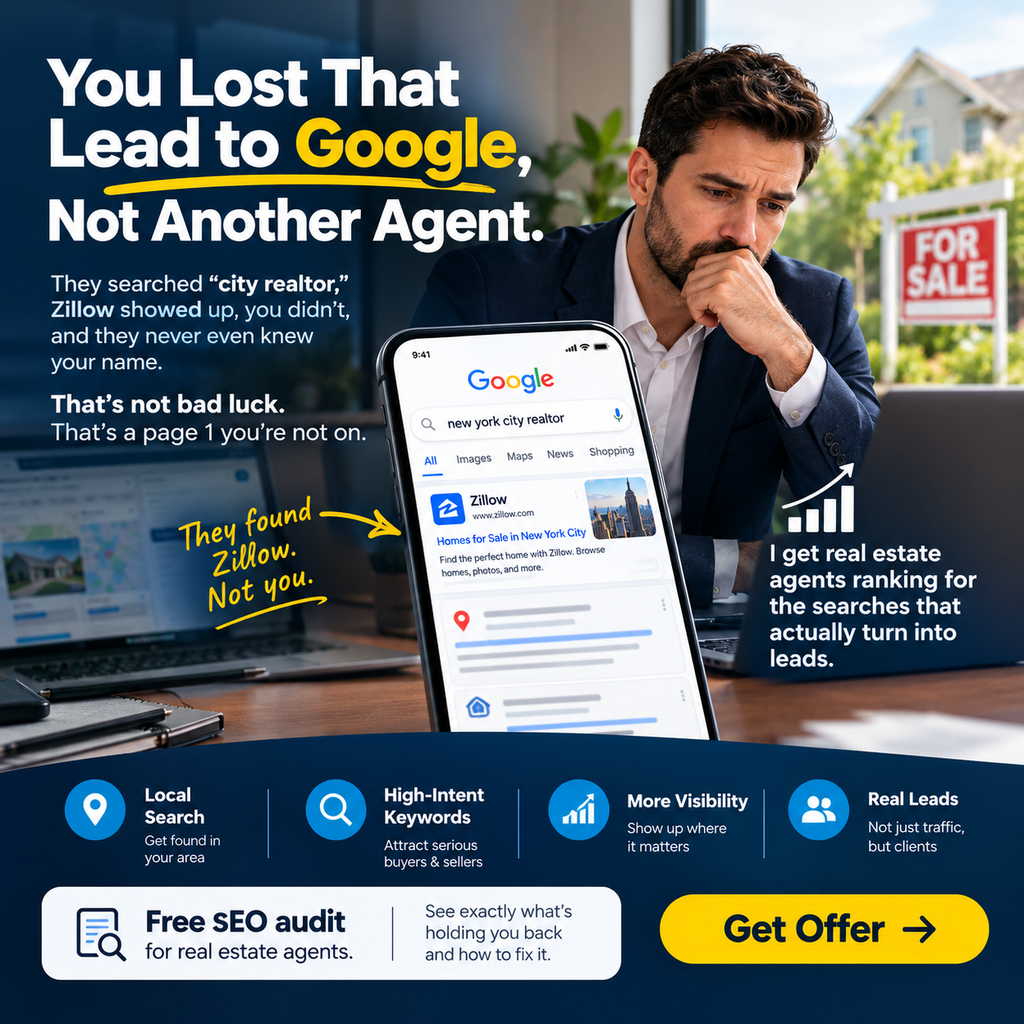
Last month, a buyer typed “[city] realtor” into Google. Zillow showed up first. Then a couple of big brokerage sites. Then a listings portal.
You weren’t anywhere on that page.
That buyer picked one of the names they saw. Not because that agent was better than you. Not because they had a nicer website or a stronger track record. Just because Google showed them first, and you never got the chance to be considered at all.
That’s the part that stings when you really think about it. You didn’t lose the deal in a negotiation. You lost it before the buyer even knew your name.
The real competition isn’t other agents
Most agents think their competition is the guy three streets over with the bigger billboard. In reality, your biggest competitor is Zillow, and you’re helping pay for the privilege of losing to them.
Every listing you upload there or on a portal site adds to their SEO strength, not yours. Google sees a site like Zillow getting fresh listings constantly, tons of backlinks, and years of authority. Your personal site, even if it’s well-built, is starting from a much smaller base.
So when a buyer searches, Google shows what it trusts most: the big aggregator. Not because your listing is worse. Because your website hasn’t been given a reason to compete yet.
97% of buyers start online. Most never scroll past page one.
This isn’t a guess. The National Association of Realtors has reported for years that the overwhelming majority of home buyers begin their search online, and multiple industry studies on search behavior show that somewhere around 75% of users never click past the first page of results.
Put those two facts together and the math gets uncomfortable fast. If you’re not on page one for the searches buyers in your city are actually typing, you’re invisible to most of the market before you’ve said a single word to them.
It’s not that your marketing is bad. It’s that it’s aimed at the wrong finish line. A nice website with no visibility is a beautiful office nobody can find the door to.
Why this keeps happening to good agents
I’ve looked at a lot of real estate websites, and the pattern repeats:
The site looks great on a phone and a desktop. The photography is strong. The bio is warm and professional. And none of it is set up to actually rank.
No city or neighborhood-specific pages. No content answering what buyers are actually searching, things like “is now a good time to buy in [city]” or “best areas for families in [city].” No internal linking strategy tying pages together so Google understands what the site is actually about. Sometimes basic technical issues too: slow load times, missing meta titles, thin content copied straight from the MLS feed.
None of these are expensive problems. They’re just invisible ones, until you understand what to look for.
What actually moves the needle
Ranking above Zillow for every keyword isn’t realistic, and honestly it’s not the goal. The goal is ranking for the searches that convert: your city, your specific neighborhoods, the property types you specialize in, the questions your actual buyers are asking before they call an agent.
That usually comes down to a few things done properly, not a hundred things done halfway:
Local landing pages built around real search intent. A page for “[city] homes for sale” is different from a page answering “best neighborhoods in [city] for first-time buyers.” Buyers search both. Most agent sites have neither.
Content that answers real questions, not filler blog posts written to hit a word count. Buyers research before they call. If your site answers their questions clearly, you become the trusted name before the first conversation even happens.
A site structure Google can actually understand. Clean internal linking, sensible URLs, fast load times. Unglamorous, but it’s the foundation everything else sits on.
Consistent presence, not a one-time push. SEO compounds. An agent who’s been building this for six months has a real head start over one who starts the week they need it.
What this actually costs you if you skip it
Every month you’re not ranking is not a neutral month. It’s buyers who searched, found someone else, and never knew you existed. Some of them were ready to buy. Some of them would’ve been a great fit for your listings specifically.
You can’t calculate the exact number, but you can feel it every time a listing sits longer than it should, or a lead comes in cold from a portal instead of warm from your own site.
Where to start
You don’t need to rebuild your entire website or throw money at ads to fix this. The first real step is understanding exactly where you stand right now: what you’re ranking for, what you’re invisible for, and what’s actually fixable versus what’s a bigger project.
That’s what a proper SEO audit tells you. Not a generic report full of jargon, a clear picture of what’s costing you visibility and what to fix first.
If you want to know where your site actually stands on Google right now, I’m doing free audits for real estate agents this week. WhatsApp me at +60 11-2987 5068 and I’ll walk you through exactly what’s happening and what it would take to fix it.
You already do the hard part, closing the deal once someone’s in front of you. Let’s make sure more of them actually find you first.